Curriculum
At Cedarbrook, we follow the Montessori approach – an educational philosophy founded by Dr. Maria Montessori, who opened the first Casa dei Bambini (Children’s House) in Rome in 1907. What started as a small classroom more than a century ago has now grown into a global movement, with over 22,000 Montessori schools in more than 100 countries.
The Montessori Philosophy lies at the heart of what we do at Cedarbrook. It encourages children to explore, make choices, and learn at their own pace – helping them build independence, confidence, and a lifelong love for learning. Even after more than 100 years, this approach continues to shape young minds around the world, and we’re proud to bring that same timeless philosophy to our community here at Cedarbrook.
The Five Areas of Montessori Learning at Cedarbrook
At Cedarbrook, the Montessori approach is designed to support your child’s whole development – emotionally, socially, academically, and practically. While Montessori is known for its five main areas of learning, each area opens the door to a rich range of experiences, including science, art, geography, culture, music, nature studies, social skills, and daily life independence.
Together, these five areas help children grow into confident, capable, and independent little learners through a warm, play-based, hands-on environment.
- Practical Life is the heart of the Montessori classroom. These everyday activities help children build independence, self-control, coordination, and responsibility.
- At Cedarbrook, children engage in simple but meaningful tasks such as:
- • pouring, spooning, sorting
- • buttoning, zipping, buckling
- • wiping tables, washing hands, caring for plants
- • helping set up and tidy their work
- • graceful movements, sharing, greeting others
- These tasks refine fine motor skills, strengthen concentration, and help children develop the confidence to take care of themselves and their environment. Children begin to feel, “I can do it myself,” which is a powerful part of early development.
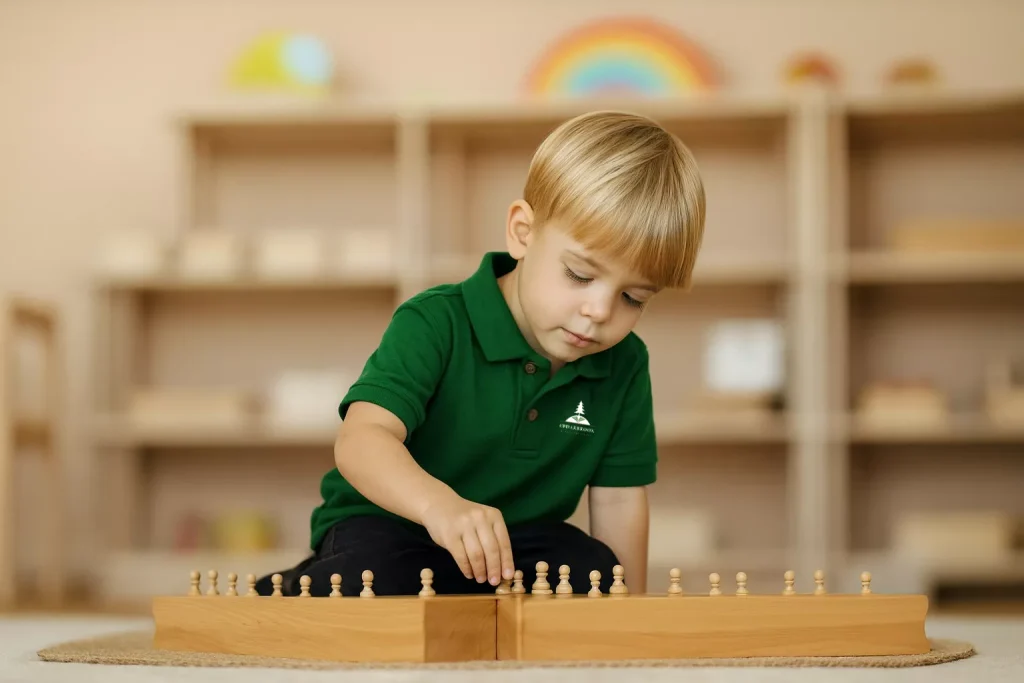
- The Sensorial area helps children make sense of the world by engaging all five senses.
- Through materials that focus on colour, dimension, shape, temperature, sound, texture, weight, and smell, children learn to compare, classify, match, and sequence.
- This area builds early foundations for:
- • science observation
- • logical thinking
- • problem-solving
- • early math and geometry
- • language and descriptive vocabulary
- By exploring materials hands-on, children deepen their awareness of the world and begin to notice details others often overlook.
- Language development in Montessori is natural, enjoyable, and connected to real experiences.
- At Cedarbrook, language grows through stories, conversations, songs, phonetic awareness, vocabulary activities, and hands-on materials.
- Children are introduced to:
- • sandpaper letters for tracing and feeling letter sounds
- • phonetic games to build early reading skills
- • movable alphabet to create words and simple phrases
- • storytelling and expressive language
- • early writing using concrete materials
- Reading and writing unfold gradually, without pressure. Children begin to understand not just letters and sounds, but the joy of communication.
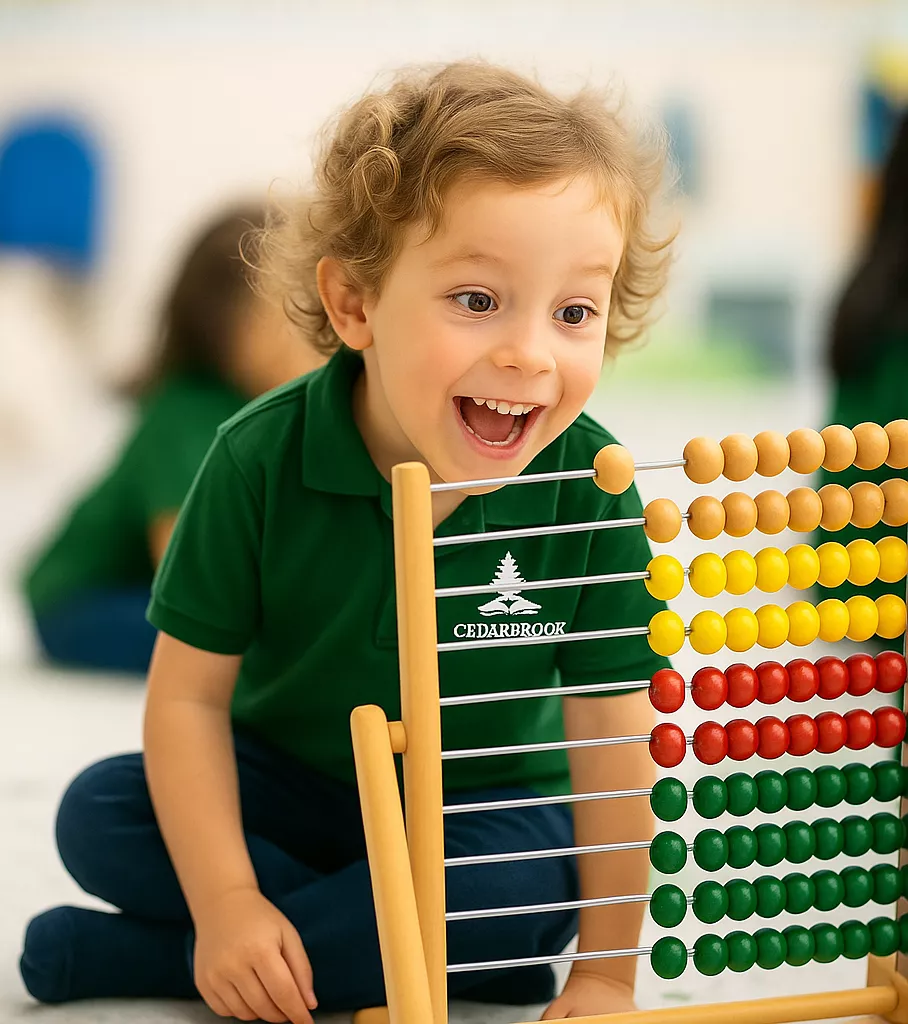
- Montessori mathematics allows children to truly understand numbers by working with materials they can see and touch.
- Children explore concepts such as:
- • numbers 1–10
- • counting and quantity
- • decimal system
- • addition, subtraction, multiplication, division
- • patterns, sequencing, and early geometry
- Instead of memorizing facts, children build a solid foundation by physically working with beads, number rods, spindles, counters, and golden bead materials.
- This helps them move naturally from concrete understanding to abstract thinking — making math feel meaningful and enjoyable.

- Cultural learning introduces children to the wonders of the world.
- This area includes a wide range of subjects such as:
- • geography (continents, landforms, maps, globes)
- • botany (plants, seeds, leaves, nature walks)
- • zoology (animals, habitats, life cycles)
- • science (simple experiments, observation, classifying objects)
- • art and creative expression
- • music, rhythm, and movement
- • cultural celebrations and traditions
- • social studies and community awareness
- These lessons help children understand diversity, appreciate nature, and develop curiosity about the world and the people in it.
A Cedarbrook Promise
Through these five foundational Montessori areas — enriched with science, art, music, geography, culture, and nature — we nurture each child’s holistic development, independence, curiosity, and love for learning in a warm, playway-inspired environment.
Why We Choose the Montessori Way - The Cedarbrook Difference
| Feature | At Cedarbrook (Montessori Approach) | Traditional Curriculum |
|---|---|---|
| Learning Method | Learning at Cedarbrook is hands-on and self-directed. Children explore real materials and learn through discovery, making every lesson meaningful and memorable. | Teacher-led lessons focus mainly on memorization and worksheets, which may limit creative thinking. |
| Learning Pace | Every child at Cedarbrook moves at their own pace. We respect each child’s growth and readiness, allowing true learning to unfold naturally. | All children follow the same lesson pace, even if some need more time or challenge. |
| Environment | Our classrooms are calm, beautifully arranged, and designed for children to move, explore, and choose their activities independently. | Traditional classrooms are more structured around the teacher’s direction, with less room for self-choice. |
| Role of the Teacher | Our educators act as gentle guides — observing, supporting, and stepping in only when needed. The focus always remains on the child’s learning journey. | Teachers lead from the front, directing lessons and controlling most classroom activities. |
| Learning Focus | We emphasize real, hands-on experiences before introducing abstract ideas. Children touch, feel, and explore to truly understand what they learn. | Traditional systems often move quickly to abstract learning, which can be harder for young children to grasp. |
| Classroom Setup | Every detail at Cedarbrook — from child-sized furniture to reachable shelves and artwork at eye level — is designed to make children feel independent and valued. | Classrooms are usually arranged for convenience of teaching rather than encouraging independence. |
