- March 25, 2026
- 7:17 pm
Every parent wants the best start for their child. In recent years, a growing number of families are turning away from conventional preschool models and choosing Montessori education instead. This shift isn’t just a trend it reflects a deeper understanding of how young children actually learn, grow, and thrive in their earliest years.
A Different Philosophy of Early Childhood Education
At the heart of the Montessori method is a simple but powerful belief: children are naturally curious, self-motivated learners. Rather than sitting at desks, following rigid schedules, and absorbing information delivered by a teacher, Montessori children learn by doing. They move freely through a carefully prepared classroom environment, choosing activities that match their developmental stage and personal interests.
Traditional preschools, while well-intentioned, often rely on structured group instruction, teacher-led lessons, and standardized routines. This one-size-fits-all approach can work for some children, but it doesn’t account for the wide range of learning styles, developmental paces, and individual strengths that young children bring into the classroom. Montessori education fills this gap by treating every child as a unique learner not a student to be molded, but a person to be guided.
Child-Led Learning and Independent Thinking
One of the most significant reasons parents prefer Montessori preschools is the emphasis on child-led learning. In a Montessori classroom, children are empowered to make choices which activity to explore, how long to work on it, and when to move on. This freedom, structured within clear boundaries, builds genuine independence and confidence from an early age.
Research in early childhood development consistently shows that intrinsic motivation doing something because it is interesting or meaningful, produces deeper learning than external rewards like stickers or grades. Montessori classrooms are built entirely around this principle. Children develop concentration, problem-solving skills, and a love for learning that carries well beyond the preschool years.
Traditional preschools, by contrast, often depend on teacher approval, group activities, and extrinsic rewards to drive engagement. While this can create short-term compliance, it rarely builds the kind of self-directed curiosity that prepares children for lifelong learning.
Hands-On, Multi-Sensory Learning Materials
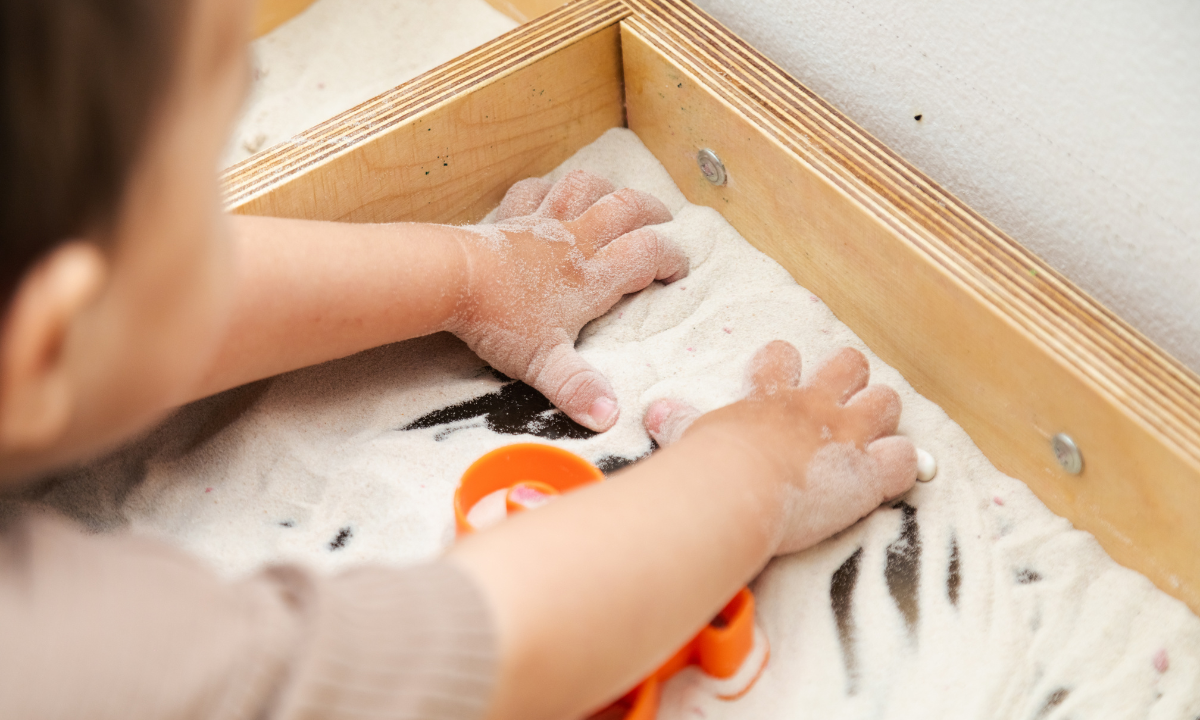
Walk into any Montessori classroom and you’ll immediately notice the difference. Instead of worksheets and flashcards, children work with beautiful, thoughtfully designed hands-on materials. From wooden number rods and sandpaper letters to puzzle maps and sensory bins, every object on the shelf has a specific developmental purpose.
These multisensory learning tools help children build concrete understanding before moving to abstract concepts a sequence that aligns with how young brains actually process and retain information. A child who physically moves beads on a counting frame develops a far stronger number sense than one who memorizes figures on a page.
This tactile, experiential approach to early learning supports cognitive development, fine motor skills, language acquisition, and mathematical thinking all at once, and all through play.
Mixed-Age Classrooms That Mirror Real Life
Another feature that distinguishes Montessori from traditional preschool is the mixed-age classroom. Rather than grouping children strictly by birth year, Montessori programs typically bring together children aged two-and-a-half to six in a single environment. Younger children learn naturally by observing older peers, while older children reinforce and deepen their knowledge by helping those who are newer to a concept.
This model reflects the social dynamics of real life far more accurately than age-segregated classrooms. It nurtures empathy, patience, leadership, and cooperation all social-emotional competencies that are critical not just in school, but throughout a child’s entire life.
Parents consistently cite this collaborative social environment as one of the key reasons they choose Montessori education for their young children.
Respect for the Whole Child
Montessori education takes a holistic view of child development. Academic readiness matters, of course but so does emotional regulation, social awareness, physical coordination, and a child’s sense of personal dignity. Montessori teachers are trained to observe children closely, follow their lead, and create conditions in which every child feels seen, valued, and capable.
In a traditional preschool setting, the emphasis is often placed heavily on school readiness benchmarks letter recognition, number counting, and color identification. While these are important, they represent only a fraction of what a young child needs to flourish. Montessori programs address the full spectrum of development: intellectual, social, emotional, and physical.
Cedarbrook: A Preferred Choice for Montessori Early Education
For parents seeking a Montessori environment that genuinely embodies these values, Cedarbrook has emerged as a preferred choice in the community. Families choose Cedarbrook not simply because it follows the Montessori method but because it brings that method to life with warmth, consistency, and deep respect for every child.
At Cedarbrook, the prepared environment is thoughtfully curated to invite exploration and independent discovery. Educators are not just trained in Montessori philosophy they are committed to it. They observe carefully, intervene gently, and create a classroom culture where children feel safe enough to take risks, make mistakes, and grow through both. Parents who visit Cedarbrook often describe a palpable sense of calm and purposeful activity children working with focus, moving with intention, and engaging with each other with genuine kindness.
The Long-Term Impact of Montessori Education
Parents who choose Montessori aren’t only thinking about preschool they’re thinking about the kind of person their child will become. Studies tracking Montessori-educated children into later schooling consistently show advantages in executive function, reading comprehension, social competence, and creative thinking. These children tend to be more adaptable, more resilient, and more comfortable with self-directed challenges.
The early years from birth to age six represent the most sensitive period for brain development in a human life. The educational environment a child experiences during this window shapes neural pathways, emotional patterns, and foundational beliefs about learning itself. Getting it right during this period is not a luxury. It is a responsibility.
Montessori education takes that responsibility seriously. And that, above all else, is why more parents are making the choice.
