- January 31, 2026
- 10:18 am
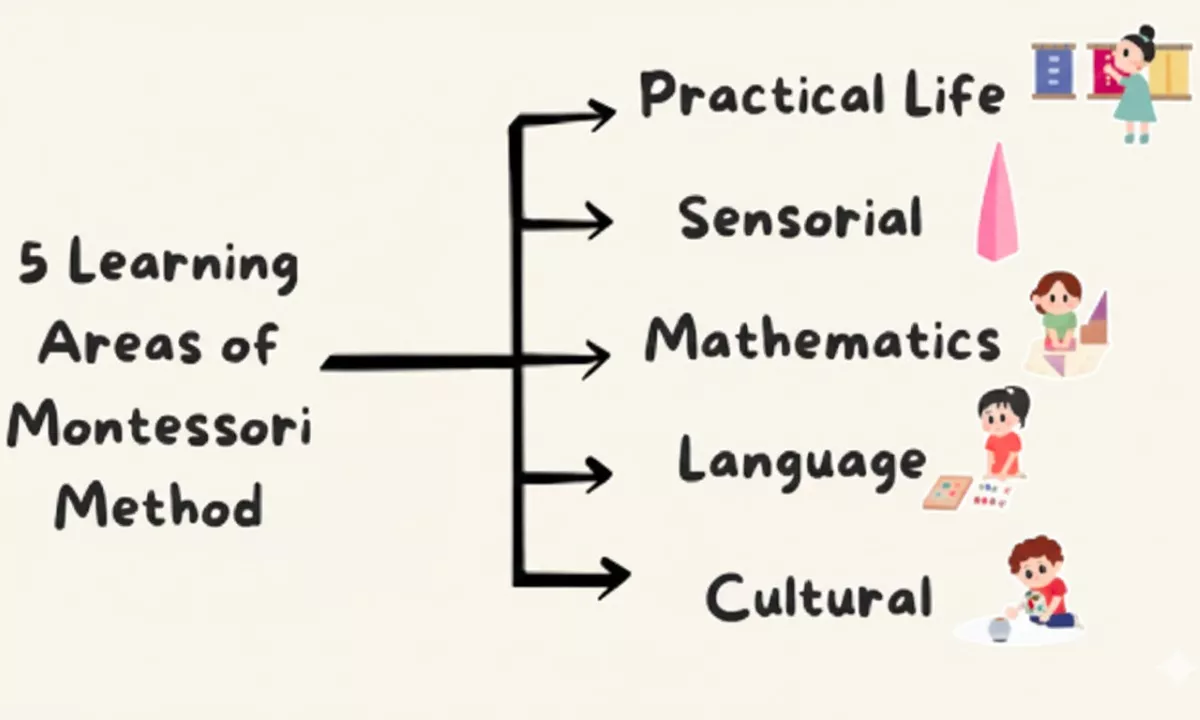
At Cedarbrook Montessori, the core of this environment is a curriculum divided into five distinct avenues of learning, designed to allow children to explore, discover, and grow at their own pace. Parents looking for answers on what their child does all day may benefit from understanding these five areas that demonstrate how play translates to significant educational growth.
At Cedarbrook Montessori , our subjects are not taught sequentially but rather integrated throughout each class, so children may seamlessly move among subjects as their interests guide them. Here is more insight into these key learning areas that form part of Cedarbrook experience.
Table of Contents
Practical Life: Establishing Independence
Practical Life is usually the first area a child engages with during early Montessori training, often beginning by pouring water, buttoning a shirt, scrubbing tables or arranging flowers. While such tasks might appear simple to outsiders, they form the cornerstone of early Montessori curriculum and must not be underestimated.
Practical Life activities serve to connect home and school life for your child by offering familiar tasks which enable him/her to feel included and contribute positively to society. Their primary aim should not simply be the cleaning up of tables and coats rather the goal should be developing order, concentration, coordination and independence among its participants.
Sensorial: Refinement of Sensations
Children are naturally sensory beings, they explore the world by touching, seeing, smelling, tasting and hearing things around them. The Sensorial area in a classroom exists to assist kids in sorting through all these impressions each day in a structured fashion and making sense of them all.
Materials in this area have been specifically created to highlight specific qualities. For instance, the Pink Tower helps visualize size discrimination while keeping colors and shapes constant; sound cylinders isolate volume/pitch relationships while color tablets isolate hue/shade relationships.
Sensorial Work
Sensorial work helps develop children’s powers of observation. For instance, children exposed to materials used for Sensorial work tend to notice subtle variations that others would miss this sets up their minds for mathematical thought later in life; when children start learning how to grade items by size or match items by pattern they’re already taking steps toward geometry and algebra!
Language Tactile Approach for Literacy Development
At Cedarbrook, language acquisition takes a multi-sensory approach that begins well before children pick up books to begin reading.
The Montessori language curriculum follows an organic progression. Teachers model rich vocabulary for children to imitate. Next comes phonemic awareness playing games to identify individual sounds within words.
Writing Before Reading
One of the hallmarks of Montessori learning centers is their emphasis on writing before reading. Through materials like Sandpaper Letters, children often start practicing writing before mastering reading an incredible process which links muscle memory with visual symbols and auditory sounds to form long term neural connections between their bodies and brains.
Mathematics: Visualizing Quantities
Mathematics may seem intimidating at first, but in a Montessori classroom it becomes exciting. Part of its genius lies in being able to make abstract concepts tangible for children.
Children don’t understand what 1,000 means on paper alone, so giving them something tangible like a golden cube that weighs as much as 1,000 beads allows them to feel its presence more readily and comprehend its quantity.
Journey To Abstraction
Cedarbrook children begin with materials representing quantities one through 10. After moving onto learning place values with beads and cards, children use manipulative materials for addition, subtraction, multiplication and division with four-digit numbers.
Due to children being physically involved with mathematics, they gain a much deeper understanding of its concepts than simply memorizing multiplication tables; instead they witness exactly what a number looks like when squared or cubed an understanding that ensures they transition easily when necessary to pencil-and-paper math with its abstract symbols holding real meaning for them.
Cultural Studies: Understanding the World
Cultural Studies encompass geography, science, history, botany, zoology, music and art to provide children with a comprehensive view of our globalized world and appreciate its variety.
Montessori schools place great emphasis on global citizenship education for their pupils. Classrooms often contain puzzle maps of continents, flags from various nations and land and water forms; children learn about diverse cultures, celebrations and lifestyles while building respect and empathy among classmates.
Science and Nature
This area brings nature into the classroom. Children learn to classify leaves, study animal life cycles and conduct basic science experiments; all activities that satisfy a child’s natural curiosity about “how things work” or where “things come from”. By including art and music into this activity area, children also understand that culture encompasses both expression and facts.
Holistic Effect of Five Areas of Focus
Although these five areas differ greatly in materials and objectives, they remain intrinsically interlinked. Focused effort learned in Practical Life helps solve long division problems in Mathematics while Sensorial work helps recognize letters in Language classes. Cultural Studies provides context for why we learn reading and counting skills.
As Best Montessori School we uses five areas to foster holistic development of each child. Not just academic acceleration Cedarbrook’s mission is building functional, capable and compassionate humans.
Cedarbrook provides an environment in which these five areas are available for exploration and provides children with an educational experience that respects the natural development of each child. Education becomes active rather than passive providing joyous paths toward discovering more.
Learn how Montessori nurtures well-rounded learners-book a tour at Cedarbrook Montessori today.
