
Every parent wants the best start for their child. But when you begin searching for early childhood programs in Ajax, Ontario, the options can feel overwhelming. Daycare centres, preschools and Montessori programs what’s actually different, and does it matter at this age?
Table of Contents
The short answer is yes. It matters significantly. The environment a child grows up in during their first five years shapes how they think, how they relate to others, and how they approach learning for the rest of their lives. At Cedarbrook Montessori School in Ajax, we see this transformation every single day and we want every family to understand what truly sets a Montessori education apart from a traditional daycare experience.
What Most Ajax Daycare Centres Offer

Traditional daycare centres in Ajax are built around a single core purpose: providing safe, supervised childcare while parents are at work. That’s a genuinely important service, and many Ajax daycare centres do it well. A typical daycare day includes a fixed schedule of group meals, nap times, outdoor play, and organized activities. Children move through the day as a group, follow the same routine regardless of individual readiness, and receive care from staff whose primary role is supervision.
Curriculum, when it exists, is often informal. Learning outcomes vary significantly from one centre to another, and educator training standards are not always consistent. For families whose main need is reliable, safe childcare, a daycare centre can absolutely fit the bill but for families who want something more intentional for their child’s development, it often falls short.
What Makes Montessori Education Different
Montessori is not just a style of classroom it’s a complete educational philosophy developed by Dr. Maria Montessori in the early 1900s and backed by decades of research. At its heart, Montessori education is built on a simple but powerful idea: children are naturally motivated to learn, and the adult’s role is to prepare an environment that supports that curiosity rather than interrupt it. In a Montessori preschool, children are not passive recipients of instruction. They are active participants in their own learning. They choose their own work, move freely within the classroom, and are encouraged to follow their interests deeply rather than hop from one activity to the next on a timer.
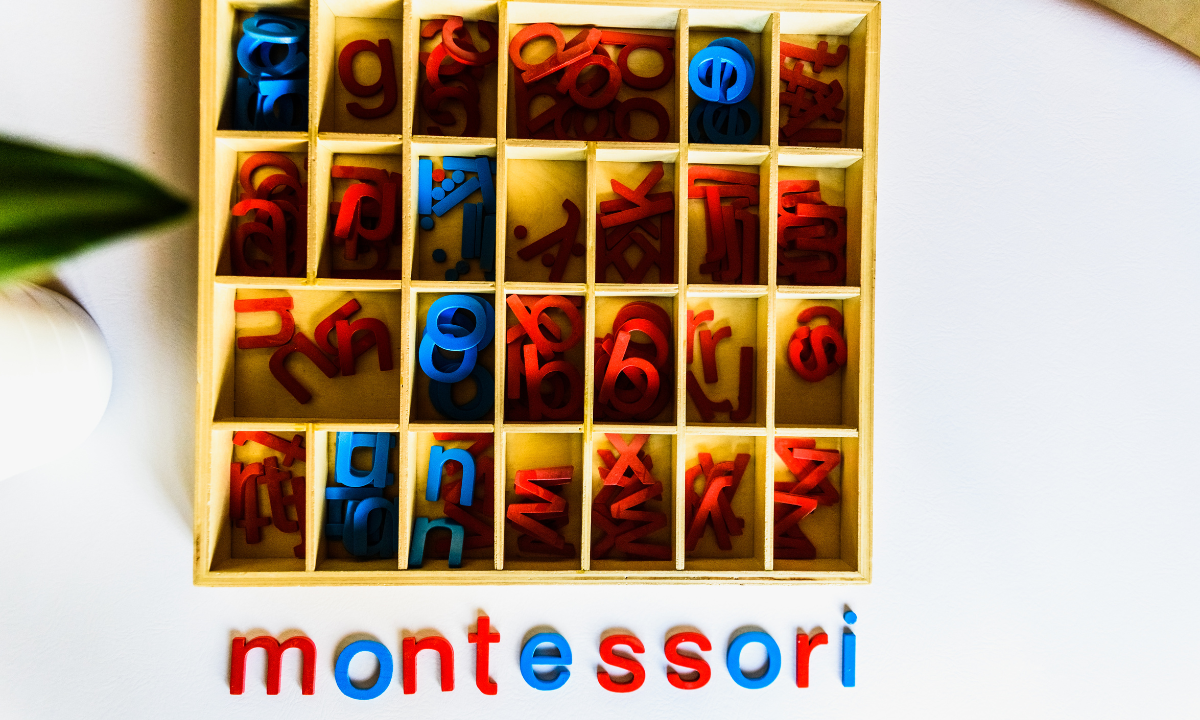
The classroom itself is carefully designed every shelf, every material, every corner of the room has a purpose. From practical life activities like pouring and buttoning to language cards, sensorial materials, and early math tools, everything invites the child to explore, practice, and discover. Nothing is accidental. Nothing is filler.
The Real Differences, Side by Side
Here’s where the two approaches genuinely diverge not in theory, but in daily experience:
Learning Approach. In a traditional Ajax daycare, learning is largely group-based and teacher-directed. In a Montessori environment, it is child-led and individualized. Each child works at their own pace and is never compared to a peer.
Educator Role. Daycare staff are caregivers first. Montessori guides are trained observers who know each child’s developmental stage intimately and offer just enough support to keep them growing without taking over.
Environment Design. Most daycare centres have a general play area. A Montessori classroom is a prepared environment deliberately arranged to invite independence, concentration, and purposeful activity.
Mixed-Age Groupings. Montessori classrooms group children across ages, typically spanning three years. This means younger children naturally learn by watching older peers, while older children reinforce their knowledge by leading and mentoring. It’s a dynamic that no single-age classroom can replicate.
Pace and Pressure. Daycare programs run on a fixed group schedule. Montessori children follow their own internal rhythm, which builds confidence, focus, and genuine self-regulation over time.
Why the Early Years Are Everything
The science is clear: the period from birth to age six is the most sensitive window for human brain development. During these years, children form the neural foundations for language, emotional regulation, social understanding, executive function, and a lifelong relationship with learning.
What this means practically is that the environment a child spends their early years in does not just affect today it shapes tomorrow. A child who learns to focus, make choices, care for their environment, and persist through challenges in a Montessori setting carries those capacities with them into primary school and beyond.
Research has consistently shown that children with Montessori backgrounds demonstrate stronger reading and math skills, better social development, greater creativity, and more developed executive function compared to peers from conventional programs. These aren’t small differences. They follow children for years.
What Cedarbrook Montessori Offers Families in Ajax
Cedarbrook Montessori School is one of Ajax’s trusted Montessori programs, serving families across Ajax, Ontario, and the surrounding Durham Region. We offer an authentic Montessori experience guided by trained, caring educators who understand child development at every stage. Our classrooms are calm, beautiful, and intentionally prepared. Our educators are certified Montessori guides who build genuine, lasting relationships with every child in their care. And our community is one where parents are welcomed, communication is open, and families feel genuinely supported.
We offer programs designed to meet children where they are from toddler programs through to kindergarten providing continuity, consistency, and the kind of deep familiarity that young children need to truly thrive.
The best way to understand Montessori is to experience it. We warmly invite you to visit Cedarbrook Montessori School, tour our classrooms, meet our guides, and see firsthand how children look when learning feels like something they chose, not something done to them.
