- July 24, 2026
- 12:44 pm
Choosing the right early learning environment is one of the biggest decisions a parent makes, and the debate over Montessori vs traditional preschool is one that almost every family in Ajax eventually faces. Both approaches aim to prepare young children for a strong academic future, but the way they get there is very different. If you’re currently comparing programs for your toddler or preschooler, this guide from Cedarbrook Montessori School breaks down exactly what sets these two educational philosophies apart.
By the end of this article, you’ll have a clear picture of which environment might be the best fit for your child’s personality, learning style, and developmental stage.
What Is Montessori Education?
Montessori education is a child-centered teaching method developed by Dr. Maria Montessori over a century ago. It’s built on the idea that children learn best when they’re allowed to explore, discover, and work at their own pace, rather than following a fixed lesson plan.
In a Montessori classroom, children choose their own activities from a range of specially designed materials. Teachers, often called “guides,” observe each child closely and step in only when needed. The goal isn’t to rush children through a curriculum — it’s to nurture independence, focus, and a genuine love of learning.
Programs like Pre-Casa, Casa, and Kindergarten Prep at Cedarbrook Montessori are structured around this philosophy, giving children aged 18 months to 6 years the freedom to grow at their own developmental rhythm.
How Montessori Classrooms Are Structured
Montessori classrooms are typically mixed-age, meaning younger and older children learn side by side. This setup encourages peer mentoring, where older children reinforce their own knowledge by helping younger ones, and younger children are inspired by watching older peers work.
What Is Traditional Preschool?
Traditional preschool follows a more conventional, teacher-directed model. Lessons are usually planned in advance, and all children in a class typically move through the same activities at the same time, following a set daily schedule.
This structure can work well for children who thrive with clear routines and enjoy group-based learning. Traditional preschools often place a strong emphasis on early literacy and numeracy through worksheets, circle time, and structured play.
Montessori vs Traditional Preschool: Key Differences
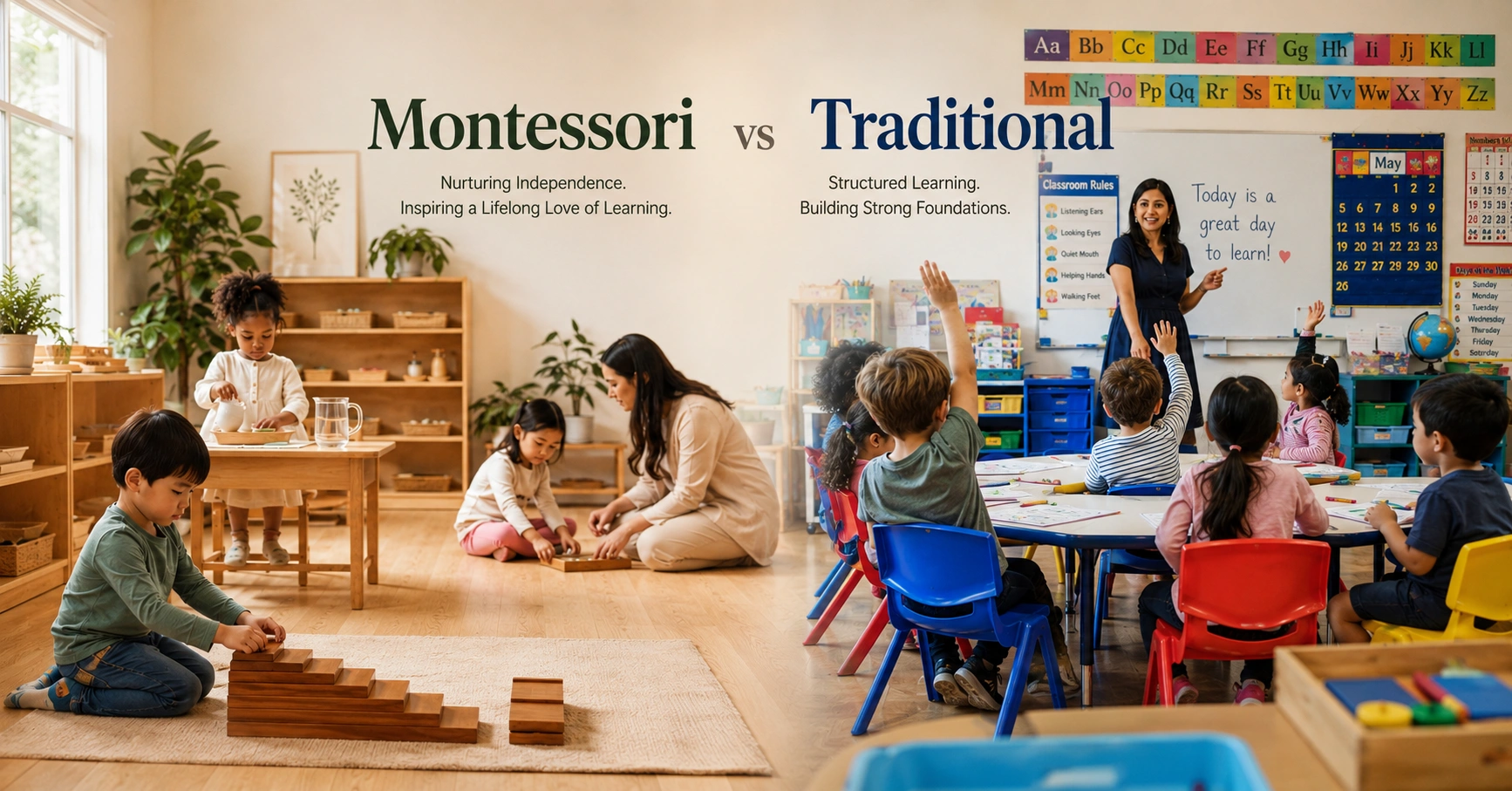
When comparing Montessori vs traditional preschool, the differences show up most clearly in five areas: classroom structure, the teacher’s role, learning pace, social development, and discipline.
1. Classroom Structure
Montessori classrooms are open and material-rich, with low shelves and hands-on tools children can access independently. Traditional preschools usually have desks or designated activity stations, with the teacher guiding the whole group through the same task.
2. The Teacher’s Role
In Montessori, the teacher acts as a facilitator, quietly observing and guiding rather than instructing from the front of the room. In a traditional preschool, the teacher takes a more active, directive role, leading lessons and setting the pace for the entire class.
3. Learning Pace
One of the most important distinctions in the Montessori vs traditional preschool debate is pacing. Montessori allows each child to progress at their own speed, repeating activities as often as they need. Traditional preschool generally moves the whole class forward together, regardless of individual readiness.
4. Social Development
Montessori’s mixed-age classrooms naturally build patience, leadership, and empathy, since children of different ages interact daily. Traditional preschools, with same-age groupings, focus more on peer socialization within a single developmental stage.
5. Approach to Discipline
Montessori encourages self-discipline through purposeful work and natural consequences, rather than rewards or punishments. Traditional preschools often use more structured behavior management systems, such as sticker charts or time-outs.
Which One Is Right for Your Child?
There’s no single “correct” answer here – it depends on your child’s temperament and your family’s priorities.
Montessori tends to suit children (and parents) who value independence, hands-on exploration, and a flexible pace. Traditional preschool may appeal more to families who prefer a predictable daily routine and a stronger focus on early academic instruction.
According to the American Montessori Society, children in Montessori environments often show stronger executive function skills, including focus, self-regulation, and problem-solving, by the time they reach kindergarten. Research published through the National Association for the Education of Young Children also highlights that both structured and child-led approaches can support strong developmental outcomes when implemented well.
Why Parents in Ajax Choose Montessori
Many families researching Montessori vs traditional preschool in Ajax ultimately choose Montessori because of its focus on real independence, not just academic milestones. At Cedarbrook Montessori School, children move through Pre-Casa, Casa, and Kindergarten Prep in a calm, prepared environment where curiosity leads the way, not a rigid bell schedule.
Our Casa program blends language, math, and practical life skills into everyday hands-on lessons, while our Kindergarten Prep program ensures a smooth, confident transition into elementary school.
If you’re weighing your options and want to see the Montessori difference firsthand, we’d love to show you around. Book a tour with Cedarbrook Montessori and see how our classrooms bring this philosophy to life.
Final Thoughts
The Montessori vs traditional preschool decision ultimately comes down to how your child learns best. Both paths can lead to happy, capable learners, but Montessori offers a uniquely personalized journey built around independence, curiosity, and respect for each child’s natural pace.
If you’d like guidance on which program fits your child’s age and personality, our team at Cedarbrook Montessori is always happy to help you find the right starting point.
